
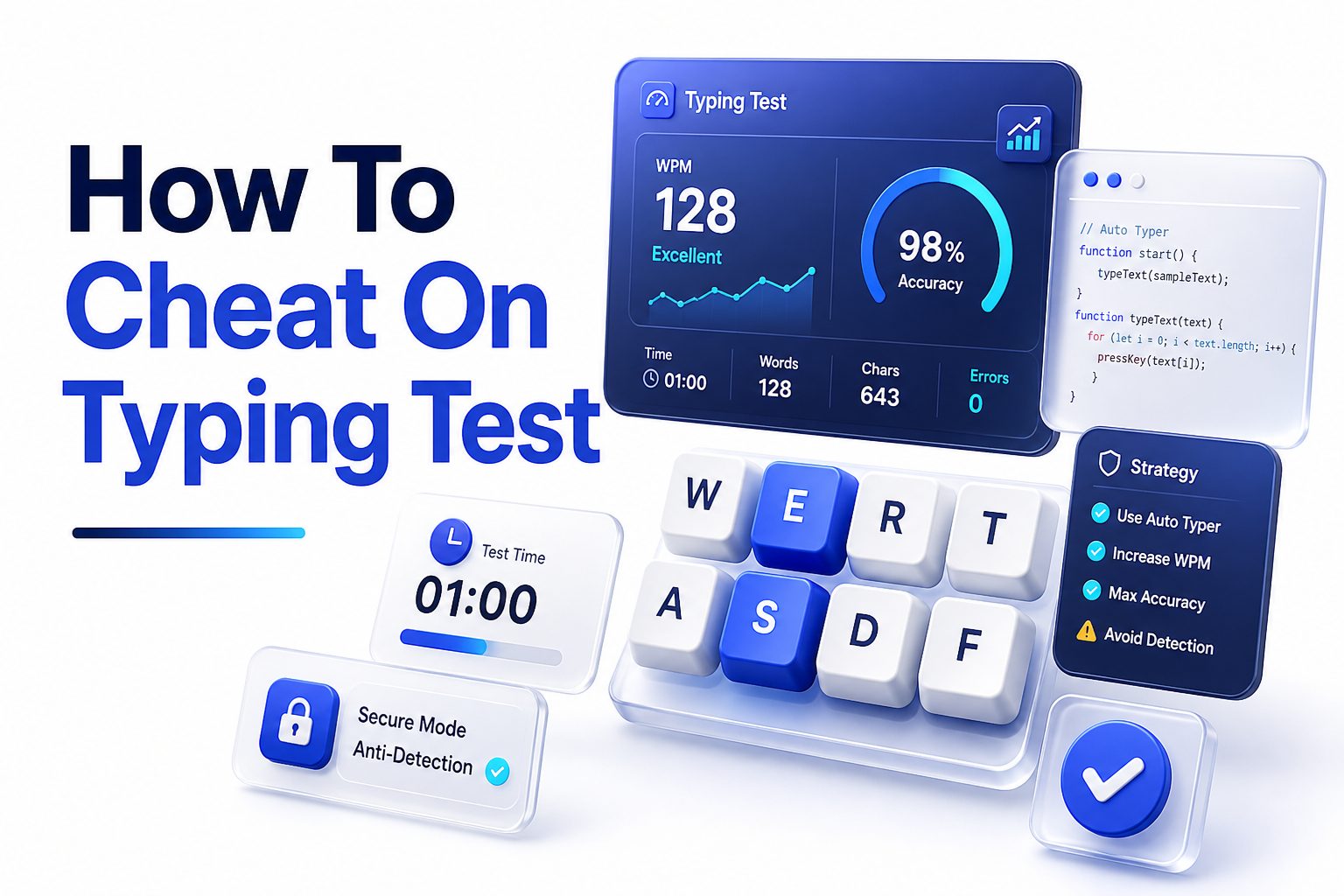
Many people search for how to cheat on typing test when they feel pressure before a school assessment, job application, certification, or online skills exam. It is a tempting search because typing tests look simple on the surface, yet the timer, accuracy score, and unfamiliar text can make even confident typists feel exposed.
The problem is that most shortcuts create bigger risks than benefits. Typing platforms often track timing patterns, pasted text, browser behavior, and accuracy spikes. A suspicious score can cost you an opportunity, damage trust, or force a retest under stricter conditions. A better approach is to know what counts as cheating, why it fails, and how to raise your typing performance in ways that hold up anywhere.
Why People Look for Typing Test Shortcuts
Most people are not trying to become dishonest test takers. They are usually anxious about a deadline, a hiring requirement, or a score that feels just out of reach. When a role demands 45, 60, or 80 words per minute, the gap can feel stressful.
The search for how to cheat on typing test often comes from poor preparation rather than lack of ability. Typing speed improves quickly with focused practice, but people underestimate how much accuracy, posture, rhythm, and familiarity with test formats affect the final result.
What Counts as Cheating on a Typing Test
Cheating usually means using outside help to create a score that does not reflect your own typing skill. This can include automation tools, copy-paste tricks, having another person complete the test, browser extensions, or scripts that input text for you.
Some people also cheat by manipulating test settings, taking screenshots for outside help, or practicing the exact passage until the result no longer reflects normal typing ability. The details vary by platform, but the principle is simple: your score should come from your own keystrokes.
Common Risks of Trying to Cheat
- Your score may be flagged by timing and input-pattern checks.
- You may be asked to retake the test live or on camera.
- Job applications can be rejected if results look suspicious.
- School or certification penalties may apply.
- A fake score can place you in work you cannot perform comfortably.
- Cheating prevents you from fixing the real cause of a low score.
Why Typing Test Cheating Usually Fails
Typing tests are easier to monitor than many people expect. A real typist makes small variations in rhythm, pauses, corrections, and key timing. Automated or pasted input often looks unusually clean, unusually fast, or inconsistent with normal human behavior.
Even when a platform does not catch cheating immediately, the result can fail later. Employers may test typing again during onboarding, remote-work setup, or live interviews. A score that cannot be repeated creates an obvious problem.
How Test Platforms Detect Suspicious Behavior
Typing platforms can record more than the final words-per-minute number. They may look at keystroke timing, mistake patterns, backspace use, copy-paste events, focus changes, and sudden jumps in speed. Some systems also use browser monitoring or supervised testing.
This does not mean every test is highly advanced, but relying on weak monitoring is a poor plan. The higher the stakes, the more likely the organization will verify the result through a second test, human review, or practical work sample.
Better Ways to Improve Your Score Quickly
If your test is coming soon, focus first on accuracy. A typist who maintains 96 to 98 percent accuracy often scores better than someone who types fast but corrects constantly. Slow down slightly, reduce backspaces, and keep your eyes on the prompt.
Next, practice in short sessions rather than long, tired marathons. Ten focused minutes repeated several times a day builds rhythm faster than one exhausting hour. Use a typing speed practice routine that includes numbers, punctuation, capitalization, and realistic workplace text.
Typing Practice Checklist
- Take a baseline test before practicing.
- Track both words per minute and accuracy.
- Practice for 10 to 15 minutes at a time.
- Fix one weak area per session.
- Use real paragraphs, not only random words.
- Rest your hands when accuracy drops.
- Retest under the same conditions each day.
How to Prepare for a Job Typing Test
Job typing tests usually care about practical output, not record-breaking speed. Data entry, customer support, transcription, administrative, and legal roles may weigh accuracy heavily because mistakes create real costs. A clean 55 WPM can be more valuable than a messy 75 WPM.
Before the test, read the instructions carefully. Some tests penalize errors immediately, while others allow corrections. Some require exact spacing and punctuation. Taking thirty seconds to learn the scoring rules can improve your result without any dishonest tactic.
What Employers Actually Want From Typing Scores
Employers use typing tests to predict whether you can handle daily tasks without slowing the team down. They want consistency, focus, and dependable accuracy. A person who can type steadily for several minutes is often more useful than someone with one inflated result.
If you feel tempted to search how to cheat on typing test for a job, ask whether the role will require that speed every day. If yes, building the skill protects you. If no, you can ask whether the test measures a core job requirement.
Honest Score Improvement Methods
Method | Best For | Main Benefit
Accuracy-first practice | Any test type | Fewer penalties and cleaner rhythm
Timed drills | Job applications | Better comfort under pressure
Weak-key practice | Plateaued typists | Faster correction of repeated errors
Copy practice | Real workplace typing | Better punctuation and capitalization
Daily retesting | Short deadlines | Clear progress tracking
The Fastest Ethical Way to Gain Words Per Minute
The quickest gains usually come from removing friction. Sit upright, keep wrists neutral, place feet flat, and position the keyboard so your shoulders stay relaxed. Physical tension wastes time and causes repeated errors during longer tests.
Then practice controlled speed bursts. Type one paragraph at a comfortable pace, one paragraph slightly faster, and one paragraph focused only on accuracy. This trains your hands to move faster without letting mistakes become the habit.
Fixing Accuracy Before Chasing Speed
Accuracy is the foundation of every good typing score. Each correction costs time, breaks rhythm, and increases stress. If your accuracy is below 94 percent, speed practice alone will usually make your test results unstable.
To improve accuracy, slow your pace until errors become rare. Pay attention to common mistakes such as skipped letters, doubled spaces, wrong capitalization, and punctuation misses. Once accuracy rises, speed tends to follow naturally.
Quick Accuracy Tips
- Read three to five words ahead.
- Keep your hands on the home row when possible.
- Avoid looking at the keyboard after every mistake.
- Correct errors calmly instead of rushing.
- Practice punctuation daily if the test includes it.
- Stop a drill when errors pile up and restart cleanly.
How to Handle Test Anxiety
Test anxiety can lower typing speed more than lack of skill. Nervous typists often hold their breath, tense their shoulders, and rush the first line. That leads to early mistakes, which makes the rest of the test feel worse.
Before starting, take two slow breaths and type the first sentence at a controlled pace. Let your rhythm build after the opening line. A steady start prevents the panic cycle that causes unnecessary corrections.
Practice Conditions That Match the Real Test
Practice should resemble the actual test as closely as possible. Use the same keyboard, browser, chair, and time limit when you can. If the real test lasts five minutes, do not only practice one-minute speed runs.
Also practice with similar content. A test with business sentences, numbers, symbols, or names will feel different from simple lowercase word drills. Matching the material helps your score transfer to the real environment.
Pre-Test Routine
Step | Action | Time Needed
1 | Warm up with easy text | 3 minutes
2 | Run one accuracy drill | 5 minutes
3 | Stretch fingers and shoulders | 1 minute
4 | Review test instructions | 1 minute
5 | Start at a controlled pace | First 30 seconds
Ethical Alternatives if You Are Not Ready
If the test is for a job and you are not yet ready, honesty can work better than a fake score. You can explain your current speed, share that you are practicing, and ask whether the score is a strict requirement or one part of the application.
For school or training programs, ask whether retakes are allowed. Many typing assessments are designed to show progress, not punish learners. A fair retake gives you time to improve without risking disciplinary trouble.
When to Ask for Accessibility Support
Some people struggle with typing tests because of injury, disability, motor limitations, visual strain, or assistive technology needs. In those cases, the right step is not cheating. It is requesting a reasonable accommodation through the proper channel.
An accommodation might include extra time, alternative input tools, ergonomic adjustments, or a different assessment format. These supports exist so the test measures relevant ability fairly, not so people are excluded by avoidable barriers.
Fair Options to Consider
- Request a retake if the platform allows it.
- Ask whether accuracy weighs more than speed.
- Use approved ergonomic equipment.
- Request accessibility accommodations when needed.
- Share a realistic typing score with employers.
- Practice with job-related sample text.
- Use [Internal Link: typing test practice tips] for structured drills.
Why Real Typing Skill Pays Off
A real typing score follows you beyond the test. It helps with emails, reports, chat support, documentation, coding, note-taking, and data entry. Even small speed gains save time every day when typing is part of your work.
The value is not only speed. Strong typing reduces mental load because your hands keep up with your thoughts. That makes writing, editing, and communication feel less tiring, especially during long work sessions.
Building a Sustainable Typing Routine
A good routine is simple enough to repeat. Choose one timed test, one accuracy drill, and one passage with punctuation. Spend 15 to 20 minutes a day on those three parts, then record your score.
Avoid changing platforms constantly. Different tests calculate words per minute differently, which makes progress harder to measure. Stay consistent for two weeks, then compare your results. For more practice structure, see [Internal Link: improve typing speed].
Sample Weekly Practice Plan
Day | Focus | Practice Goal
Monday | Baseline test | Record speed and accuracy
Tuesday | Accuracy | Stay above 97 percent
Wednesday | Weak keys | Fix repeated mistakes
Thursday | Punctuation | Practice symbols and capitalization
Friday | Timed test | Match real test length
Saturday | Mixed text | Build endurance
Sunday | Review | Compare scores and adjust
What to Do If Your Score Is Lower Than Expected
A lower score does not always mean you are a poor typist. It may reflect stress, unfamiliar formatting, a stiff keyboard, cold hands, or unclear test instructions. Review what happened before deciding your skill level is fixed.
Look at the pattern of mistakes. If most errors came from punctuation, practice punctuation. If speed dropped halfway through, build endurance. If you kept correcting the same letter pairs, target those combinations instead of repeating random tests.
How to Talk About Typing Speed Honestly
If an application asks for your typing speed, use a score you can repeat. A good rule is to report the result you can achieve on a normal day with high accuracy, not your best-ever score under perfect conditions.
For resumes, include typing speed only when it matters to the role. Write it plainly, such as “Typing speed: 62 WPM with high accuracy.” That statement is more credible than an inflated number that collapses during a live assessment.
Final Preparation Tips
- Sleep well before a high-stakes test.
- Use a keyboard you know when allowed.
- Close distracting tabs and notifications.
- Read instructions before the timer starts.
- Type the first line calmly.
- Prioritize accuracy over frantic speed.
- Do one warm-up, then stop over-practicing.
Conclusion
Searching for how to cheat on typing test is usually a sign that the test feels stressful, rushed, or unfairly important. Still, cheating creates risks that can follow you into school, hiring, certification, or daily work. A suspicious score may be flagged, challenged, or exposed the moment you need to type in a real setting.
The better path is practical and faster than most people expect. Focus on accuracy, practice under similar conditions, learn the scoring rules, and build a short routine that targets your weakest patterns. If you need support because of a disability or injury, request an approved accommodation instead of trying to bypass the test. A real score gives you confidence, protects your reputation, and prepares you for the work behind the assessment.
FAQ
Is it illegal to cheat on a typing test?
It depends on the setting, but it can violate school, certification, or employer rules. Even when it is not a legal issue, it can lead to rejection, discipline, retesting, or loss of trust.
Can typing test websites detect cheating?
Many platforms can detect suspicious behavior such as pasted text, unusual timing, sudden speed spikes, focus changes, or automation patterns. Higher-stakes tests may also include live supervision or follow-up testing.
What is a good typing speed for most jobs?
For many office roles, 40 to 60 WPM with strong accuracy is acceptable. Data entry, transcription, legal, and support roles may expect higher speeds, often with strict accuracy requirements.
How can I improve my typing score in one week?
Practice daily in short sessions, focus on accuracy first, use the same test length as the real assessment, and target repeated errors. Avoid exhausting practice sessions that make your hands tense.
Should I mention my typing speed on a resume?
Mention it only when typing matters for the role. Use a realistic score you can repeat with good accuracy, such as “60 WPM with 97 percent accuracy,” rather than your highest one-time result.
0 Comments